
|
|
| Sugimoto Genkaku Sadamitsu |
| The Pursuer of Wabi-Sabi and the Momoyama Spirit |
 |
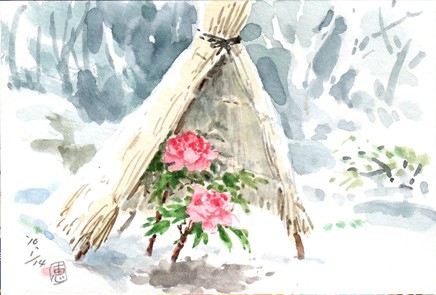
| Wabi-Sabi One Japanese poem writen by Daito Kokushi the founder Daitokuji temple expressed "Wabi-Sabi" thought. “Do not mistake it for a beggar in straw
mats; it is a winter peony, blooming in the cold." This poem perfectly captures the spirit of Wabi-sabi. At first glance, the flower is covered in rough straw mats to protect it from the snow, looking like a beggar in rags. However, inside is a noble peony. It teaches us that true beauty is often hidden beneath a humble or weathered exterior. |
 |
| "In the spirit of Wabi-sabi, Sugimoto refines his worls by distilling form to its absolute necessity. His works do not seek to impress through outward luxury, but rather
to resonate through their silent, inner strength." |
|
Returning to the Momoyama Era Fueki Ryuko
Sugimoto strives to integrate these legendary perspectives while forging his own unique "Ryuko" through his pottery and Zen paintings. [A Modern Call for Wabi-Sabi] In today’s complex and chaotic world, Sugimoto believes the spirit of Wabi-Sabi is more essential than ever. His work is not merely about preserving tradition; it is a spiritual endeavor to express the profound harmony between nature and the human soul. From his intense Shigaraki and Raku-ware tea bowls to his evocative Zen ink scrolls, every piece is an invitation to experience the depth of Japanese spiritual culture. |
| Pottery Collection |
 |
| Statue |
 |
| Zenga |
 |
| E-MAIL mail@japanartweb.com |


